
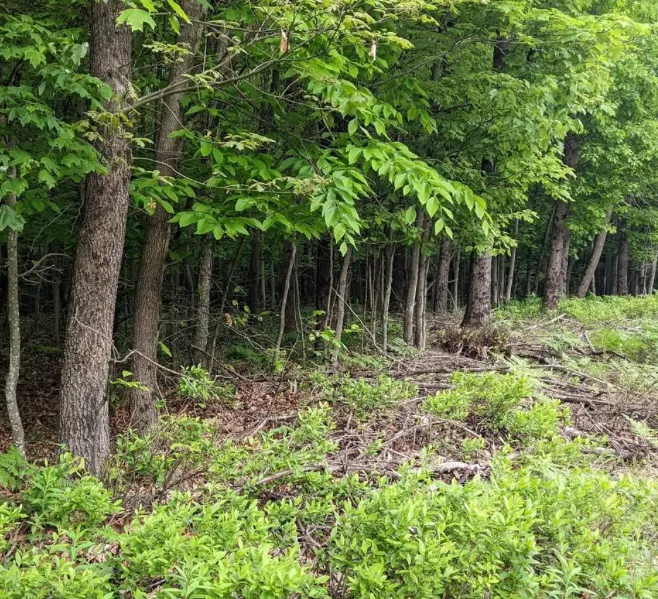
This was the question addressed for the benefit of conservation commission members from Thetford, Norwich, and other towns, as well as diverse landowners, on an educational woods walk organized by the Upper Valley Land Trust. The walk was led by Windsor, VT County Forester Dan Healey and Grafton, NH County Forester James Frohn.
The first thing to note about this walk was that it was in the Norwich-Hanover area, the Upper Valley epicenter of high deer concentrations and high deer over-browsing. Two factors account for this: firstly, the subdividing of land into rural suburbia-style parcels that frequently carve driveways and clearings into the woods; secondly the propensity of landowners to prevent hunting on their land by posting their property. According to Vermont Fish and Wildlife biologist Nick Fortin who was also in attendance, deer are heavily favored by such forest clearings because they provide a sense of security — multiple escape routes into nearby tree cover — coupled with high amounts of food. Here sunlight can reach the forest floor to support the rapid growth of tender young saplings, brambles, herbaceous plants, and wildflowers that account for 70 to 90% of a deer's diet. Gardens and orchards, if accessible, offer further sources of nutritious foods.
An average deer eats between 9 and 12 pounds of fresh forage a day — roughly two 5-gallon bucket loads.
Well-nourished deer produce more offspring. With good forage most adult females (does) produce twins and a proportion may bear triplets.
According to wildlife biologist Fortin, as one moves further and further away from the Hanover-Norwich area the high concentration of deer gradually diminishes. But deer don't stick exclusively around housesite clearings, they travel a home range — in Vermont that's typically somewhat less than a square mile. In traveling they also browse whatever the forest has to offer that's to their liking. Large numbers of deer doing that leads to the problem of over-browsing.
Over-browsing is most obvious when it's heavy. Tell-tale signs include what's known as a "browse line" on trees and shrubs where there are no twigs or branches lower than a height of 5 or 6 feet — the extent of a deer's reach. Young trees and shrubs are reduced to a stunted "bonsai" like appearance as deer repeatedly eat away the new buds and twigs.
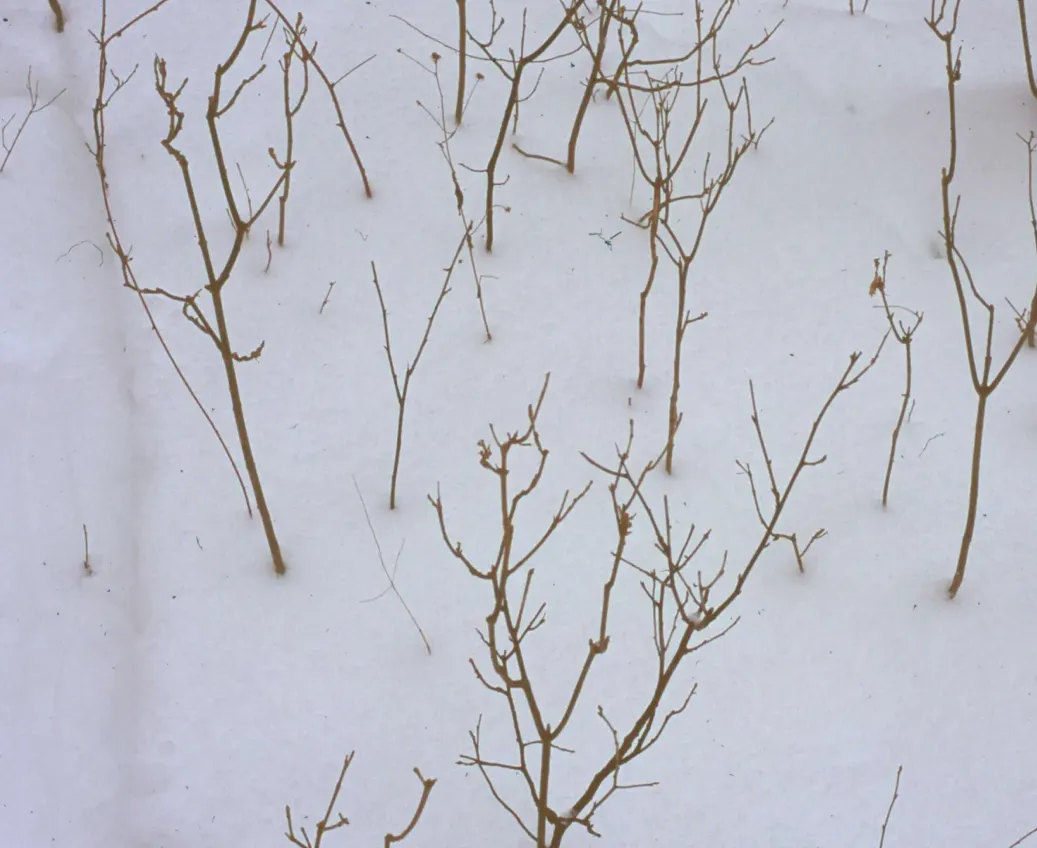
Deer-browsed twigs often have a tell-tale ragged look because deer have no upper front teeth. Thus they tear at vegetation using their lower front teeth against their hard upper palate. (Twig-nipping mammals like snowshoe hare cut off twigs at a clean diagonal.) Deer also use their lower front teeth to strip off tree bark in the winter, leaving long vertical tooth marks.
Deer are choosy eaters and favor valuable hardwoods like oak, sugar maple, ash, and some birch species. What often grows in their place are the species least liked by deer, such as beech, striped maple, and hornbeam. Very heavy browsing can remove almost everything from the forest floor, leading to a park-like appearance devoid of the usual understory of seedling and sapling trees. This space doesn't stay empty, it becomes a foothold for invasive plants such as barberry and multiflora rose that are thorny and unpalatable and honeysuckle that deer don't eat either.
Another group of plants favored by over-browsing are ferns, often hay-scented fern, that deer do not eat. This fern spreads rapidly by its underground rhizomes and can be seen filling forest clearings in huge monocultures. Hay-scented ferns block the regeneration of forest tree seedlings mainly by shading them out. In addition many ferns exert an effect known as allelopathy. Fern roots exude chemicals that directly inhibit germination of seeds, such as tree seeds, and also stunt the elongation of roots and stems should those seeds manage to germinate. Once established, these fern monocultures are almost impossible to eradicate.
Last, and sadly not least, deer eat many wildflowers, including orchids, lilies, and trilliums. The disappearance of one's favorite trillium patch is a sure sign of too many deer.
By their selective browsing, deer are devastating the forest habitat. It doesn't stop with the plants. Without the natural multi-layers of understory from saplings to shrubs to herbaceous plants, bird populations drop significantly because their foraging and nesting habitats are gone. Annihilation of insect host plants, from oaks to native herbaceous species, reduces the biodiversity and numbers of insects that are a large and critical component of the food web for birds, amphibians, and more.
The best antidote for deer overbrowsing is to allow hunting. Landowners who are concerned about hunting close to their homes should put up Safety Zone signage that prohibits shooting within 500 ft of buildings.
Humans long ago extirpated the natural deer predators, chiefly wolves and cougars (aka catamounts). Coyotes can kill vulnerable fawns and a pack can take down an adult deer in deep snowpack. However state wildlife agencies target coyotes as a species that can be killed by humans year-round. Black bear can also kill fawns, as can bobcats on occasion, but these latter predators don't take healthy adult deer.
This account covers the most visible and severe aspects of deer over-browsing. As with many things, there is a continuum from low intensity browse, through moderate intensity, to heavy and then severe over-browsing.
Readers who wish to appreciate the whole gamut may access the deer Browse Rating system developed cooperatively by The Woodland Owners Association, the Vermont Department of Forests, Parks and Recreation and the Vermont Department of Fish and Wildlife at the following link:
Scroll down to Page 121 to find this:
State of Vermont, Department of Forests, Parks and Recreation
Use Value Appraisal | Minimum Management and Plan Standards
Appendix E: Browse Rating.
Comments 1
Sign in to join the conversation. It’s free, no password needed.
Sign inOne problem with hunting, is that unlike the predation of wolves, coyotes, etc, hunters are not targeting the weak, the injured, the sick, the old, they want a healthy specimen, the best in the herd. Therefore, I do not see them as improving the health of the herd, only limiting their numbers. Plus , I've been witness to the behavior of certain hunters, like the one who was shooting in my yard one Sunday morning at 6:00 am. When I opened my window to find out what he was up to, he said he had shot a duck by the river and was now tracking it for the kill. In my yard, no less! I should have taken down his name and reported him. As far as invasive species go, I have left my fence line grow up between my fields and found that the honeysuckle, the grape vines and black rasberries have created an impermeable fence which has kept my neighbor's cows from coming into my fields, something his meagre fencing was not doing. What I found is that the bird population in my yard exploded! I had many more species living on my property because they had safer places to nest, a food source with open fields nearby to forage insects and berries in those brush. That led to more predatory birds living neraby like owls, hawks, falcons,even a few eagles have flown by. My neighbor's cats do take out some birds but my dog does a great job of escorting the cats back to their home. He likes cats and has been trained not to harm them and not to go after birds. Turkeys walk around in my yard and he doesn't give them a second glance. My old cat wil not hunt birds either. You can train animals to go after what is allowed and what is not. My cat is a great mouser but looks the other way when a bird is in sight. Training works! Years ago, my standard poodle was standing on the porch when a deer ran through the yard and my neighbor's two dogs took after it. My standard poodle watched them with disgust and stayed put, yet she thought nothing of bringing home dead ground hogs. I didn't like to see that, but it was helpful for me because I had horses. I have never sprayed my yard so it is free of poisons. I have so many tree frogs and toads and I love these wonderful creatures. Maybe someday, I will give up the fields and let the forest grow back. Maybe those trees will make up for some of the land clearings that went to create park and rides for vehicles.