
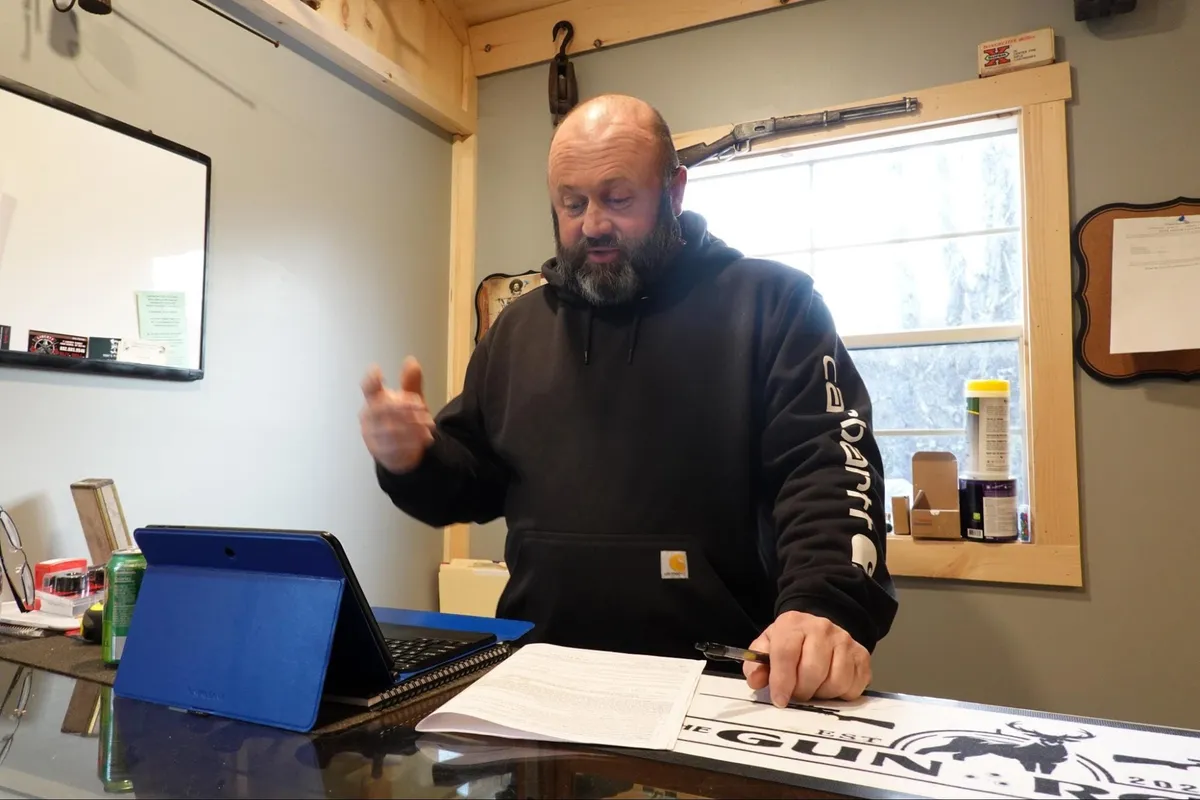
Chad Martin has always lived around guns because, like many rural Vermonters, he is from a hunting family. He shares the general Vermont attitude toward gun ownership, which is low key and practical. Guns are tools for hunting rather than for show or status. Gun violence in the state is low. Vermont had the tenth lowest gun death rate in the US in 2019, even though anyone who can legally possess a firearm is allowed to carry it concealed without a permit. Over the past several years, Vermont has enacted several common-sense gun safety laws.
Chad’s grandfather once operated a gun shop in White River Junction. He later moved to Tunbridge and for a while ran the gun shop out of his home. During visits to his grandparents, Chad remembers looking at his grandfather’s gun collection, a bookshelf stacked with handguns beside his grandfather’s chair and a cabinet of long guns. Grandpa would often pull out the latest additions to the collection to show his grandson.
People with a particular interest often become collectors without setting out with that intent. Orchid lovers can’t help but fill their homes with orchids, book lovers amass large home libraries, there are collectors of plastic ducks, road signs (tut tut), garden gnomes, beer cans, old computers, etc. Chad is an avid hunter and obtained his hunting license in 1986 as a young teenager. As a senior in high school, he was honored to be the only one of five grandchildren to inherit one of his grandfather’s personal rifles. He had also received guns as gifts before the old man passed away. It’s not surprising that Chad followed in his grandfather’s footsteps and began slowly acquiring a collection of sporting guns.
The collecting accelerated after Chad discovered online auctions of used guns. At this point, going through the background check for each individual purchase became onerous, and in 2023 he decided to obtain a Federal Firearms License (FFL) that required a major and exhaustive background check. This is the same license that is required to become a gun dealer, and Chad applied with the idea of such a business in mind.
As part of the background check for someone aspiring to trade in guns, the Federal Bureau of Alcohol, Tobacco, Firearms and Explosives (ATF) called the Thetford Zoning Administrator. They were seeking assurance that it was indeed legal for him to operate a gun business from his home in Thetford Center. Armed with this tip, the ZA informed Chad that he needed to apply for a Conditional Use Permit to open a gun shop. The application process included a hearing before the Thetford Development Review board to which all abutters were invited so their concerns and objections could be considered. After reassurances that there would be no firing range associated with the business, the permit was granted. Conveniently, the Upper Valley Fish and Game Club operates a shooting range close by on Five Corners Road, should anyone wish to test a gun out before buying.
Chad’s small shop, The Gun Room in Thetford Center, is now open, albeit sporadically, when he’s not working his other job.
thegunroomvt (at) gmail.com (802)299-6492.
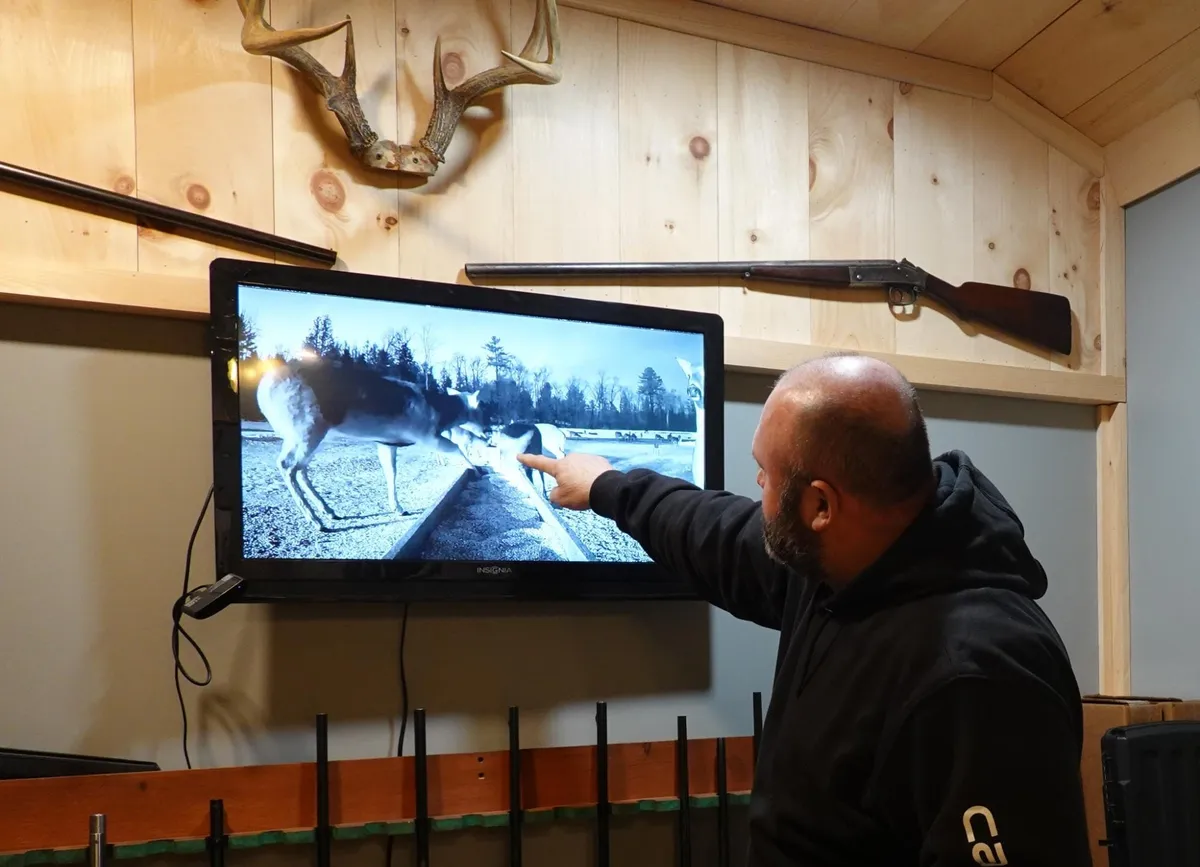
It is a neat and tidy space with a glass display case under the counter for handguns and a computer with which he applies for background checks on prospective gun buyers. There is a rack of sporting rifles at the rear and a freestanding rack displaying several shotguns. Chad hopes that they might tempt a customer in view of the upcoming turkey season. Ammunition and some hunting supplies like “Scent Away” that allows hunters to conceal their smell, doe urine lures, knives and a wooden turkey caller are also offered. Adorning the walls are several racks of antlers that are trophies from the hunting days of Chad’s grandfather. One of them, as Chad points out, is a ten-pointer that appears to be a genetic relative of the nearby eight-pointer on the wall, because the brow tines of both curve to the outside. There is also a wall mounted TV screen on which customers can view, if they wish, the Brownsville Food Pantry for deer in Brownsville, Maine. This is a state-run deer feeding operation to “get more deer through the winter.“ Vermont does not allow the feeding of deer because it encourages the spread of Chronic Wasting (aka Mad Cow) Disease. Certainly there is no shortage of deer in Thetford, as anyone with a garden can attest to.
The deer population does need to be kept in check. In absence of their natural predators like wolves and cougars, over-browsing by deer is damaging the health of Vermont’s forests, decimating young sugar maple, oak, yellow birch and ash in particular. Contrary to popular lore, coyotes are not a threat to the deer population and are persecuted needlessly. Their predations are limited to winter-weakened deer and some fawns in the spring. Human hunters are the chief form of deer population control. Often, as in Chad’s case, hunting is a family tradition that maintains bonds between generations. It acquaints humans with the natural world. Indeed, many hunters are adept amateur wildlife biologists and woodsmen. There is also the economics. The Vermont Fish & Wildlife Department reports that hunters spend more than $292 million in Vermont annually and contribute significantly to the state’s economy. Let’s hope a sliver of that comes to support one small, locally-owned enterprise, the Gun Room in Thetford Center.
Photo credit Li Shen
Comments 3
Sign in to join the conversation. It’s free, no password needed.
Sign inThanks for the post. Hunting is a great tradition that provides quality food to many. The part I have a tough time with is the argument that buck hunting protects our forests. If we really cared primarily about the health of the forests and the deer population, why not allow a lot more doe hunting? It would result in many more successful hunts, and the population would be much easier to control. Maybe I'm missing something?
Thanks for your comment Dan. Unfortunately VT Fish & Wildlife gets a lot of its budget from the sale of deer hunting licenses. Therefore they are reluctant to reduce the deer herd to under 10 per square mile as recommended by foresters, because many hunters would fail to bag a deer and the sale of licenses would decrease as a result. Deer density varies with habitat in VT, for instance there are 32 deer per square mile in the agricultural Champlain Islands. F&W would like to reduce that to 18 per square mile. More information on VT deer herd management :https://www.burlingtonfreepress.com/story/news/2022/05/11/hunting-antlerless-deer-control-overpopulation-vermont/9728994002/
And if you want to read more about the damage deer are doing to our forests read https://northernwoodlands.org/articles/article/effects-deer-forest-ecosystems
I appreciate your concern - and your readership of Sidenote!
Thanks for your response, Li Shen. I knew a bit about Fish and Wildlife- your info was very helpful. I believe it was Mark Twain who said "We have the best Gov't that $ can buy". Nobody wants their taxes to go up, but there's certainly a potential conflict of interest.